In GEO, we mostly work blind. We put questions to ChatGPT, Perplexity or Gemini, note the sources they cite, then try to guess why those ones were chosen and not ours.
On 17 October 2026, DeepSeek shifted the picture slightly: its search engine can now be queried via API, and every result comes with an authority score and a ranking score. For the first time, we can read what an AI search engine thinks of a source before a model uses it to answer.
Here is what the documentation says, what a first public test showed, and what I take from it for managing a brand's visibility in AI answers.
Key takeaways
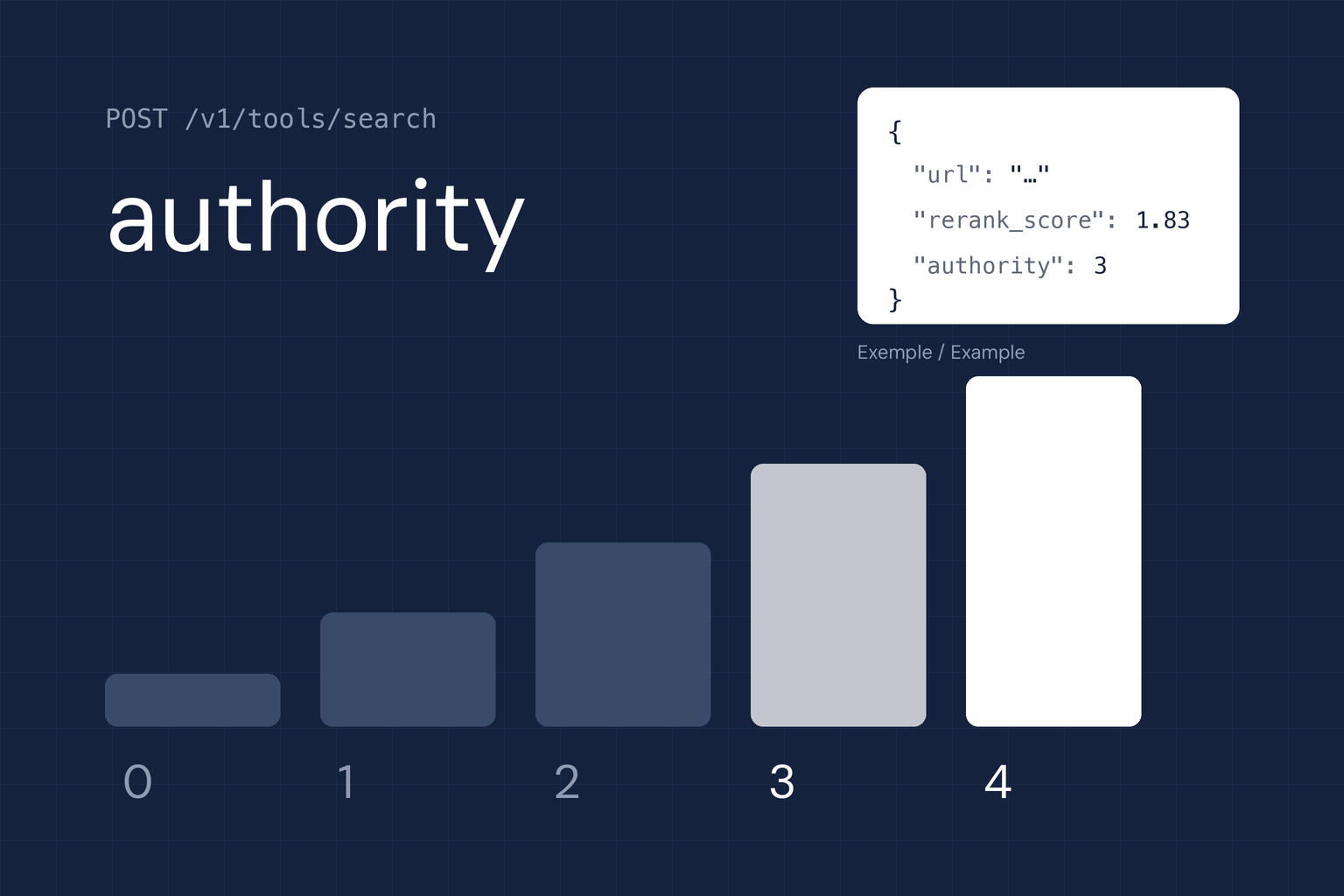
DeepSeek's Search API returns, for each result, an
authorityscore from 0 to 4 and arerank_scorefrom 0 to 3.In the first published test, authority behaved like a score assigned to the host (the site or subdomain), not to the page.
The direct consequence: good content on a low-scoring site starts at a disadvantage, and parasite content hosted on a high-scoring site inherits its score.
Pages without a readable date disappear as soon as a date filter is applied.
These observations come from a single day of testing from one country. They are leads to verify, not rules.
What DeepSeek has opened up
According to its changelog, DeepSeek relies on its own search engine, which reportedly indexes “hundreds of billions of web pages” and handles “hundreds of millions of search requests” every day. The company also claims to filter out SEO spam, GEO manipulation and low-quality AI content.
Two APIs are available (Search & Fetch documentation):
Search (
POST /v1/tools/search): returns up to 50 structured results for a query of up to 128 characters. It accepts thesite:,-site:,after:andbefore:operators, plus alocalizationfield that takes an IP address to localise results.Fetch (
POST /v1/tools/fetch): retrieves a page and returns it as Markdown.
On pricing, DeepSeek's announcement, as reported by Suganthan, gives $0.75 per 1,000 calls per API. The documentation states that a call is only billed if it returns results, and that the number of results requested does not change the price. A hundred or so queries therefore costs less than $0.10.
Two scores to read on every result
| Field | Scale | Official definition |
|---|---|---|
authority | 0 to 4 (-1 = unknown) | The page's authority level. From 3 upwards, the source is considered highly reliable. |
rerank_score | 0 to 3 | A score combining relevance, authority and freshness. From 1.5 upwards, the result is considered good quality. |
These definitions come from the Search API reference. The key point: the documentation describes a page score. The first public test suggests otherwise.
What the first public test shows
On 17 October, launch day, Suganthan published a detailed test: 110 calls from Dubai, for around $0.08. All the figures in this section come from his article. I have not reproduced them.
The scores appear to rank the results
Across 1,000 results from 20 SEO and GEO queries, the ranking score ranged from 0.75 to 2.70, with a median of 1.63. Results were sorted by this score, and 68% were above the 1.5 threshold.
| Authority | Share of results | Median ranking score |
|---|---|---|
| 1 | 2% | 0.95 |
| 2 | 32% | 1.45 |
| 3 | 60% | 1.83 |
| 4 | 6% | 1.98 |
The higher the authority, the higher the median ranking score. This correlation does not measure the exact weight of authority in the ranking, but it shows the field is worth tracking.
Authority behaves like a host score
Across 16 site: queries covering 12 hosts, every URL on the same host had the same score. A few of the examples recorded:
| Host | Authority |
|---|---|
| suganthan.com, growth-memo.com | 1 |
| ipullrank.com, brodieclark.com, medium.com, reddit.com | 2 |
| ahrefs.com, moz.com, searchengineland.com, aleydasolis.com, linkedin.com | 3 |
| zenodo.org | 4 |
The most telling detail concerns Reddit: qh.reddit.com scores 1, while www.reddit.com scores 2. The unit therefore seems to be the host (the subdomain), not the whole domain.
On a site: query, his own site returned 50 pages, all scored 1. Being indexed is therefore not enough: indexing and scoring are two separate things.
Platforms rank ahead of publishers
On six queries precisely describing his own tools, his pages ranked 32nd and 48th at best, and four times fell outside the top 50. Ahead of them: PyPI, npm, Apify, the Chrome Web Store, wordpress.org and GitHub. On a “tool” query, a listing on a recognised platform beat the publisher's own page.
The spam filter lets parasite content through
Despite the filtering promise, the test surfaced:
“Free Robux Generator” PDFs uploaded via a form on a US government host (oig.dc.gov), scored 4;
“BEST CBD GUMMIES EXPOSED” pages on a Columbia University host, scored 4;
a former UK MP's domain that now serves casino content, scored 3 and ranked 2nd for “best casino sites uk”.
These cases do not tell us how much spam DeepSeek removes. They show that a high host score can cover pages that do not deserve it. This is exactly the mechanics of parasite SEO, carried over to AI search engines.
Without a date, a page vanishes from filtered searches
The after: and before: operators worked without errors, but they also excluded every page without a recognised date. In the sample, 11% of results had no date. For a news query filtered by date, those pages simply no longer appear.
The Fetch crawler presents itself as Firefox
The Fetch API requests observed did not identify themselves as DeepSeek: a Firefox 149 user agent on Linux, zh-CN language, Huawei Cloud IP addresses in Hong Kong (AS136907). The crawler loaded CSS but did not execute JavaScript. It also returned the content of three URLs disallowed by robots.txt. The author could not verify whether the crawler read the robots.txt file.
These observations concern the Fetch API, not necessarily the crawler that builds DeepSeek's index.
What I take from this for GEO
1. The host becomes the unit of work. If the score is confirmed at host level, the question “where to publish?” matters as much as “what to publish?”. Strategic content placed on an isolated subdomain, a separate blog or a microsite starts with that host's score, not the main site's.
2. Platform presence is part of GEO work. For a tool or a piece of software, a clean, legitimate listing on the platform where that type of product lives (browser extension store, marketplace, specialist directory) can rank ahead of your own site. It is a lever, not a workaround.
3. A machine-readable date is no longer a detail. Publication and update dates should be visible on the page and marked up in structured data (datePublished, dateModified). Then check that the engine actually picks them up.
4. Content must exist without JavaScript. A crawler that does not execute it only sees the initial HTML. Text loaded afterwards by JavaScript does not exist for it.
5. robots.txt is not enough to control access. For this crawler, it did not prevent the tested pages from being retrieved. If a brand wants to control this access, the work happens at server level, and with caution: blocking the entire Huawei Cloud network or every Firefox signature would also affect real visitors.
The limits of these observations
The sample is small. One day, 110 calls, six target queries, a single calling country. The author himself describes the results as “directional”.
Correlation is not explanation. We can see that well-scored hosts rank better, not how much the score weighs against relevance or freshness.
DeepSeek is neither Google nor ChatGPT. Its scores say nothing directly about how other engines judge a site. Their value lies elsewhere: it is the only AI search engine, to date, that shows its scores. We use it as a laboratory.
Behaviour may change. The API is only a few days old. The scores, filters and crawler may change without notice.
Repeating the test in your market
The published test was run from Dubai, on English-language queries. For a French or European brand, it needs to be repeated under its own conditions:
Record each host's score with one
site:query per domain and per subdomain: yours, and those of three or four competitors.Choose around twenty queries that matter for revenue, not for ego: comparison, selection and objection questions.
Set the localisation with an IP address from the target market. Without this field, DeepSeek appears to use the caller's IP, and your audit reflects wherever your script happens to run.
Record four values per result: rank, URL, authority, ranking score. Rerun them on fixed dates to track how they change.
Test with and without a date filter to spot the pages the engine considers undated.
A starting point in Python, with the API key stored in an environment variable:
import os, requests

API = "https://api.deepseek.com/v1/tools/search"
HEADERS = {"Authorization": f"Bearer {os.environ['DEEPSEEK_API_KEY']}"}

def search(query, ip, count=50):
    r = requests.post(API, headers=HEADERS, timeout=30,
                      json={"query": query, "count": count, "localization": ip})
    r.raise_for_status()
    return [(rank, x["url"], x["authority"], x["rerank_score"], x["date"])
            for rank, x in enumerate(r.json()["results"], start=1)]
A hundred or so billed calls costs less than $0.10 at the announced rate. For a first measurement, budget is no obstacle.
In summary
The value of this API is not DeepSeek's market share in Europe, which remains modest. It is that it makes visible the scores other AI search engines keep to themselves. For the first time, we can measure how an engine judges a source, rather than assume it.
The first results point in a direction SEO knows well: host reputation matters, distribution matters, basic technical signals (date, readable HTML) matter. GEO does not replace these fundamentals. It makes them more visible.
Sources: DeepSeek changelog (17 October 2026), Search & Fetch documentation, Search API reference, test published by Suganthan.