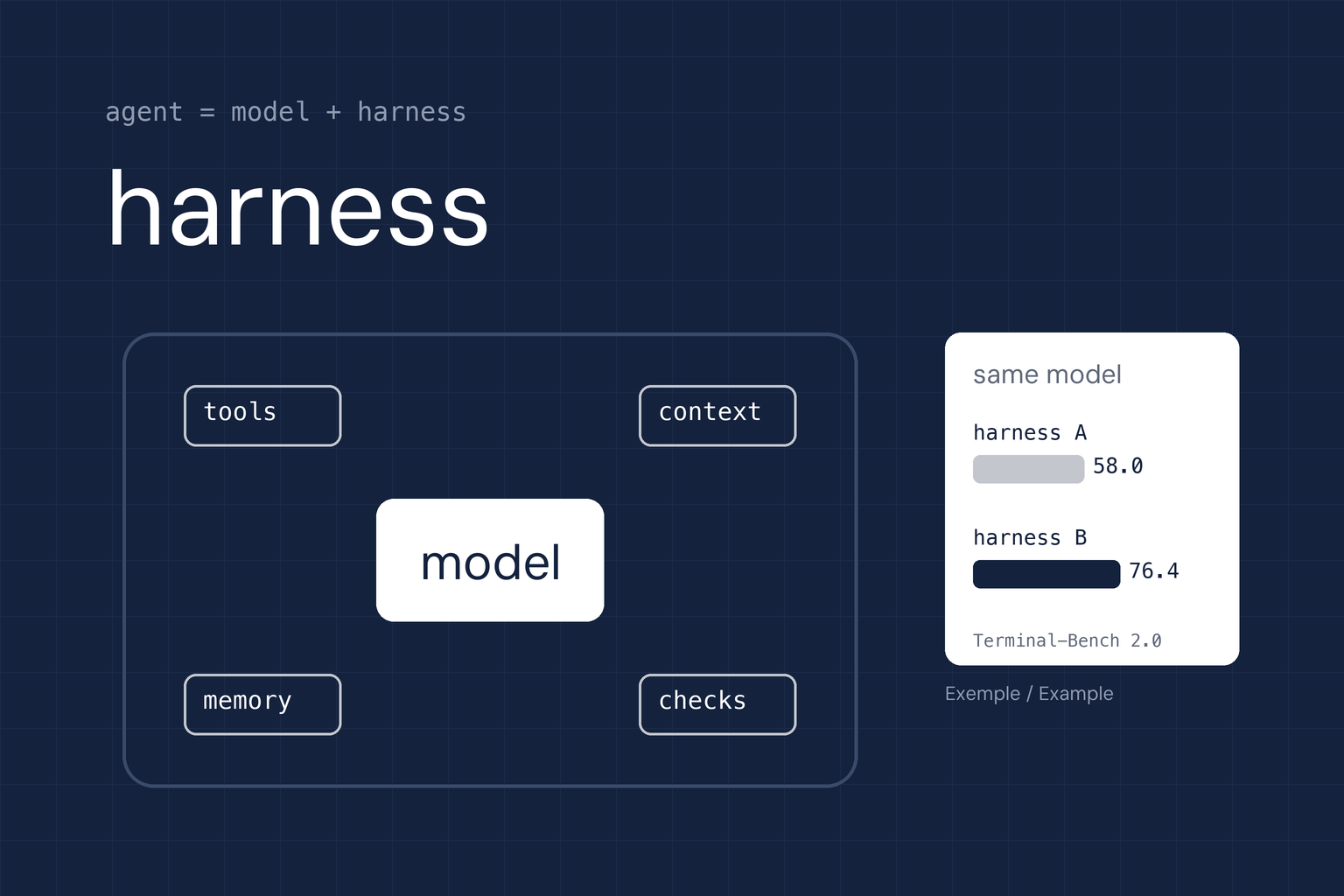
When people compare AI agents, they almost always compare models: Claude versus GPT, GPT versus Gemini. It's like looking at the engine and forgetting the car.
Since the start of 2026, one word has taken hold among the people who build these agents: the harness. It is everything around the model that lets it act. And the measurements published this year show that it weighs at least as much as the model on the outcome.
I use a harness every day for my SEO and GEO work. Here is what I took away from the sources, how I would choose today, and the honest answer to the question everyone asks: does it improve SEO?
Key takeaways
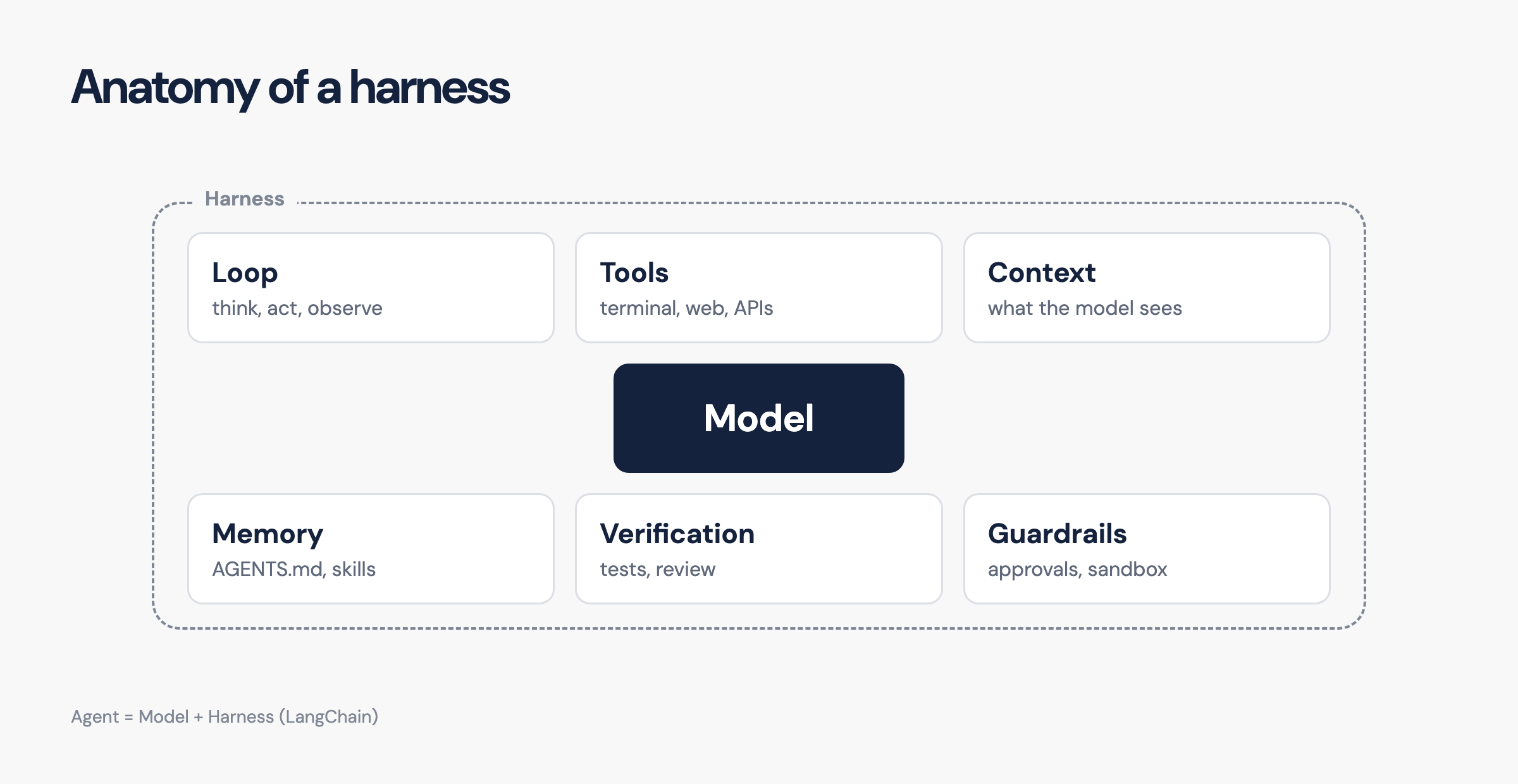
A harness is the whole agent except the model: tools, context management, memory, safety rules, verification loops. LangChain sums it up in one formula: Agent = Model + Harness.
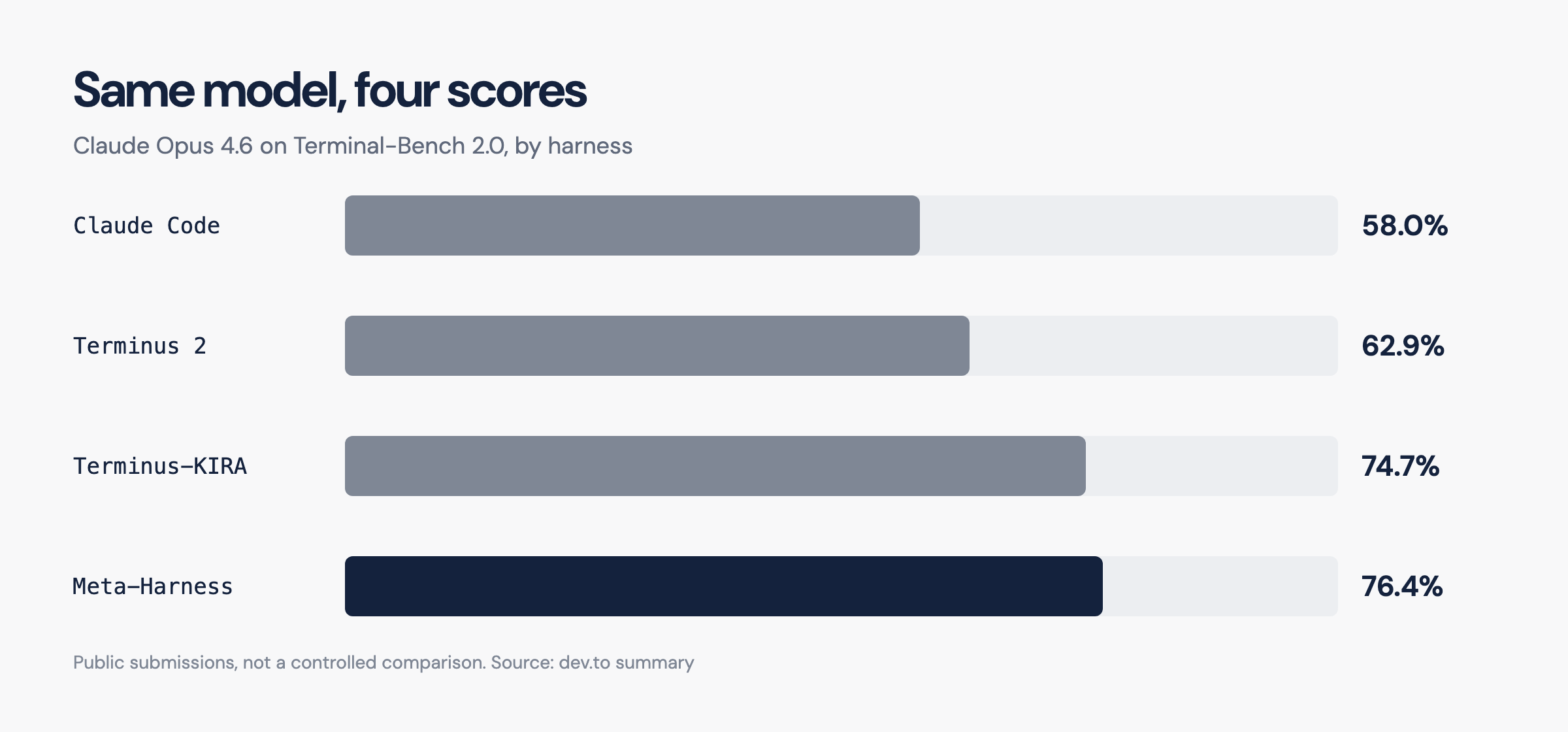
On the same benchmark, the same model goes from 58.0% to 76.4% depending on the harness, according to figures taken from Terminal-Bench 2.0. The authors warn that this is not a controlled experiment.
An October 2026 study of 66 configurations shows that model rankings flip from one harness to another, and that the vendor's own harness is not always the best one for its own model.
There is no best harness in the absolute. There is a good model and harness pairing for a given task, and it has to be tested.
A harness does not make a site rank. It changes the quality and consistency of SEO work, and it can also produce mass content that Google penalizes. The effect depends on what you ask it to do.
What is a harness?
The word comes from equipment: the harness that connects the horse to the plow. The horse supplies the strength, the harness makes it useful. Applied to AI agents, the image holds up well.
LangChain gives the most quoted definition: "Agent = Model + Harness". The model contains the intelligence, the harness is the system that makes it useful. Martin Fowler takes up the same idea: the term covers everything in an agent except the model itself.
In practice, a model on its own receives text and returns text. It doesn't read your files, open a browser, or remember anything from one session to the next. The harness does all of that:
| Component | What it does | Example |
|---|---|---|
| Agent loop | Runs the model: it thinks, calls a tool, reads the result, starts again | The core of Claude Code, Codex or Hermes |
| Tools | Gives the model hands: terminal, files, web search, browser | A bash access, a Search Console API |
| Context | Decides what the model sees at each turn and summarizes what overflows | Compaction of a long session |
| Memory and instructions | Keeps rules and learnings from one session to the next | AGENTS.md, CLAUDE.md, skills |
| Verification | Checks the work before it reaches the human | Tests, linters, review by a second agent |
| Guardrails | Sandbox, approval requests, limited permissions | Confirmation before any deletion |
OpenAI describes the Codex harness in the same terms: what helps the model gather context, use tools, stay within configured limits, ask for approval and keep working from one turn to the next.
Where the term "harness engineering" comes from
The term became popular in the first half of 2026. On February 5, Mitchell Hashimoto, co-founder of HashiCorp, published his AI adoption journey, one step of which is titled "Engineer the Harness". His method is simple: every time the agent gets a command or an API wrong, he adds a line to the project's AGENTS.md file. Each line corresponds to an observed mistake.
OpenAI then published its own write-up under the title "Harness engineering". The lesson I find most useful: give the agent a map, not a 1,000-page manual. Context is a scarce resource. A giant instruction file crowds out the task, and when everything is "important", nothing is.
Anthropic, for its part, documented how to make an agent work across several sessions. Their harness separates an initializer agent, which prepares the environment, from an agent that moves forward in small steps. Three files serve as the common thread: a JSON feature list that the agent is only allowed to tick off, a progress file, and the git history. The problem they fix is telling: without this framework, the agent declares the project finished too early.
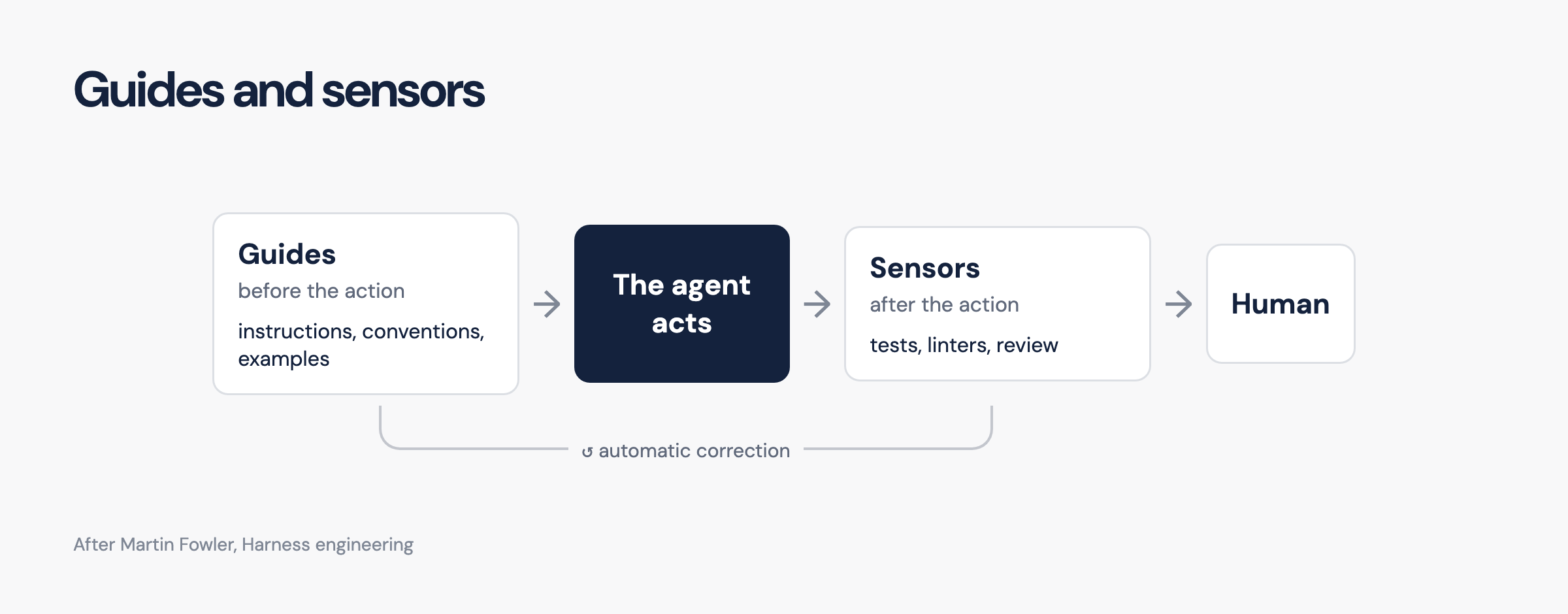
Martin Fowler offers the clearest framework for thinking about all this. A harness has two types of controls: guides, which steer the agent before it acts (instructions, conventions, examples), and sensors, which observe afterward and help it correct itself (tests, linters, review). A good harness increases the odds of getting it right the first time and catches as many errors as possible before a human sees them.
The harness weighs as much as the model
This is the part that should change how you choose your tools. Several measurements published in 2026 point the same way.
| Measurement | Same model, results by harness | Source |
|---|---|---|
| Terminal-Bench 2.0, Claude Opus 4.6 | 58.0% with Claude Code, 62.9% with Terminus 2, 74.7% with Terminus-KIRA, 76.4% with Meta-Harness | dev.to summary of a research paper |
| Terminal-Bench 2.1, GLM-5.2 | 59.8% with OpenCode, 65.4% with Claude Code, 69.0% with Cursor, 72.6% with Kimchi | test published by Kimchi |
| ARC-AGI-3, GPT-5.6 Sol | from 13.3% to 38.3% by preserving reasoning and compacting context, with six times fewer output tokens | OpenAI |
The most solid study I found comes from Nanyang Technological University, published on October 1st, 2026. The authors tested 66 configurations: four configurable harnesses (OpenHands, DeepSeek Harness, Pi, openJiuwen) with five models, on three benchmarks, plus the native pairings of Codex with GPT and Claude Code with Claude. Their conclusions:
Model rankings flip depending on the harness. On Terminal-Bench 4, Claude beats GPT by 7.94 points in OpenHands, but trails by 30.16 points in Pi.
The vendor's harness is not always the best for its own model.
Paying more does not guarantee a better score. On Terminal-Bench 4, GPT does better under Pi than under DeepSeek Harness for less than a quarter of the cost per task.
What makes the difference: how the harness feeds failures back to the model, in a form it can use.
A position paper goes further and speaks of a "limiting constraint": on long tasks and between models of comparable level, harness configuration would explain more of the variation in results than the choice of model. Evaluation protocols would therefore credit the model with gains that come from the harness.
The limits of these numbers
These are not my measurements. I did not reproduce any of these tests. The figures are the authors'.
Public comparisons are not controlled. The 18-point gap on Claude Opus 4.6 compares submissions that may differ in prompts, versions and token budgets. The authors say so themselves, and part of Claude Code's score came from broken tasks, fixed in version 2.1 of the benchmark.
Kimchi is judge and party. Their test ranks their own harness first. The result remains interesting for the 13-point gap, not for the podium.
There is a contrary view. According to The Deep Feed's summary, the Terminal-Bench authors believe that the choice of model generally matters more than the harness. The debate is not settled.
Code benchmarks are not SEO tasks. None of these tests measures an audit, a keyword analysis or a piece of writing.
What remains solid is the direction: the same model does not give the same result in two different harnesses. You can no longer choose your tool by looking only at the model's name.
The 2026 landscape: Hermes, OpenClaw, OpenBot and the others
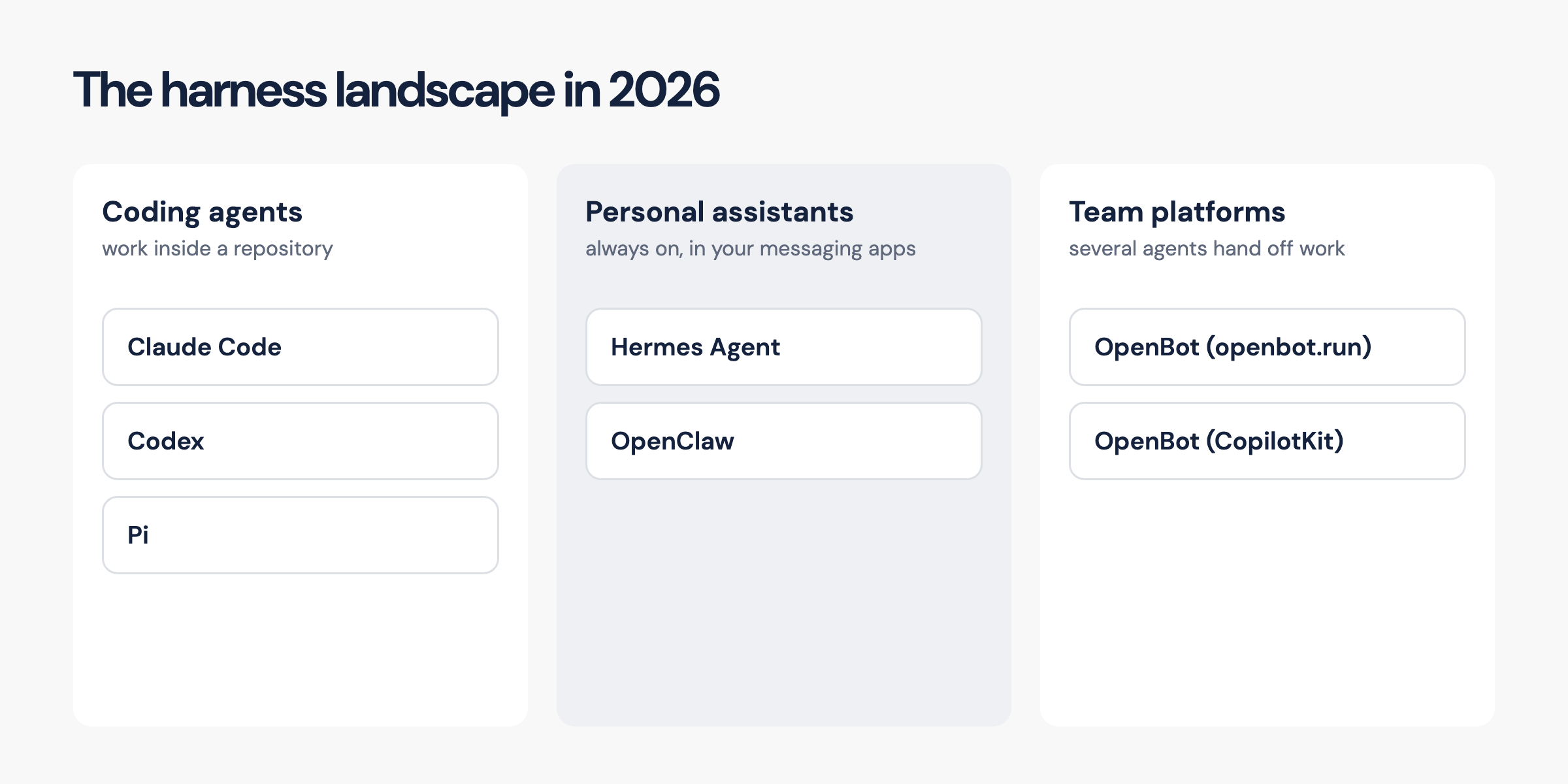
Harnesses fall into three families. Coding agents, which work inside a repository. Personal assistants, which live in your messaging apps and run continuously. Team platforms, which orchestrate several agents.
| Harness | Family | What sets it apart | License |
|---|---|---|---|
| Claude Code | Code | Complete extension layer: CLAUDE.md, skills, MCP, subagents, hooks, plugins | Anthropic |
| Codex | Code | Open source harness that OpenAI also exposes as a platform for other applications | Open source |
| Pi | Code | Minimal, extensible harness: no subagents or plan mode by default, you add what you need | MIT |
| Hermes Agent | Personal assistant | Learning loop: it creates skills from experience and improves them with use. A single process for Telegram, Discord, Slack, WhatsApp, Signal and the terminal | MIT (Nous Research) |
| OpenClaw | Personal assistant | The most popular: over 380,000 GitHub stars as I write. Runs on your devices, replies on more than twenty messaging apps | MIT |
| OpenBot (openbot.run) | Team | Persistent "teammates" on your computer, who hand tasks to each other. Runs Codex, Claude Code, Gemini, OpenCode or Pi with the subscriptions you already pay for | PolyForm Noncommercial (commercial use under a separate license) |
| OpenBot (CopilotKit) | Team | An enterprise assistant hosted on your infrastructure, each agent with its own browser, files and permissions | MIT |
Beware the naming trap: two different projects are called OpenBot. The one at openbot.run is desktop software, free but non-commercial by default. The one from CopilotKit is an MIT-licensed project designed for companies. Check which one is being recommended to you.
A few useful details:
Hermes Agent follows the open agentskills.io standard for its skills, loaded only when needed to save context. It is the one I use daily: my procedures (publishing an article, checking a figure before sending it to a client) are written there once, then reused.
OpenClaw changed names twice in January 2026 (Clawdbot, then Moltbot, then OpenClaw). Its creator, Peter Steinberger, joined OpenAI in February, and the project moved under a foundation, according to Wikipedia.
Security is a real issue for personal assistants, which have access to a terminal and to your messaging apps. OpenClaw's documentation publishes a comparison with Hermes that lists security reports on the Hermes side. This is a competitor writing: read it as a list of points to check, not as a verdict. OpenBot (openbot.run) itself warns that its agents can modify files and run commands without asking each time.
How to choose a good harness
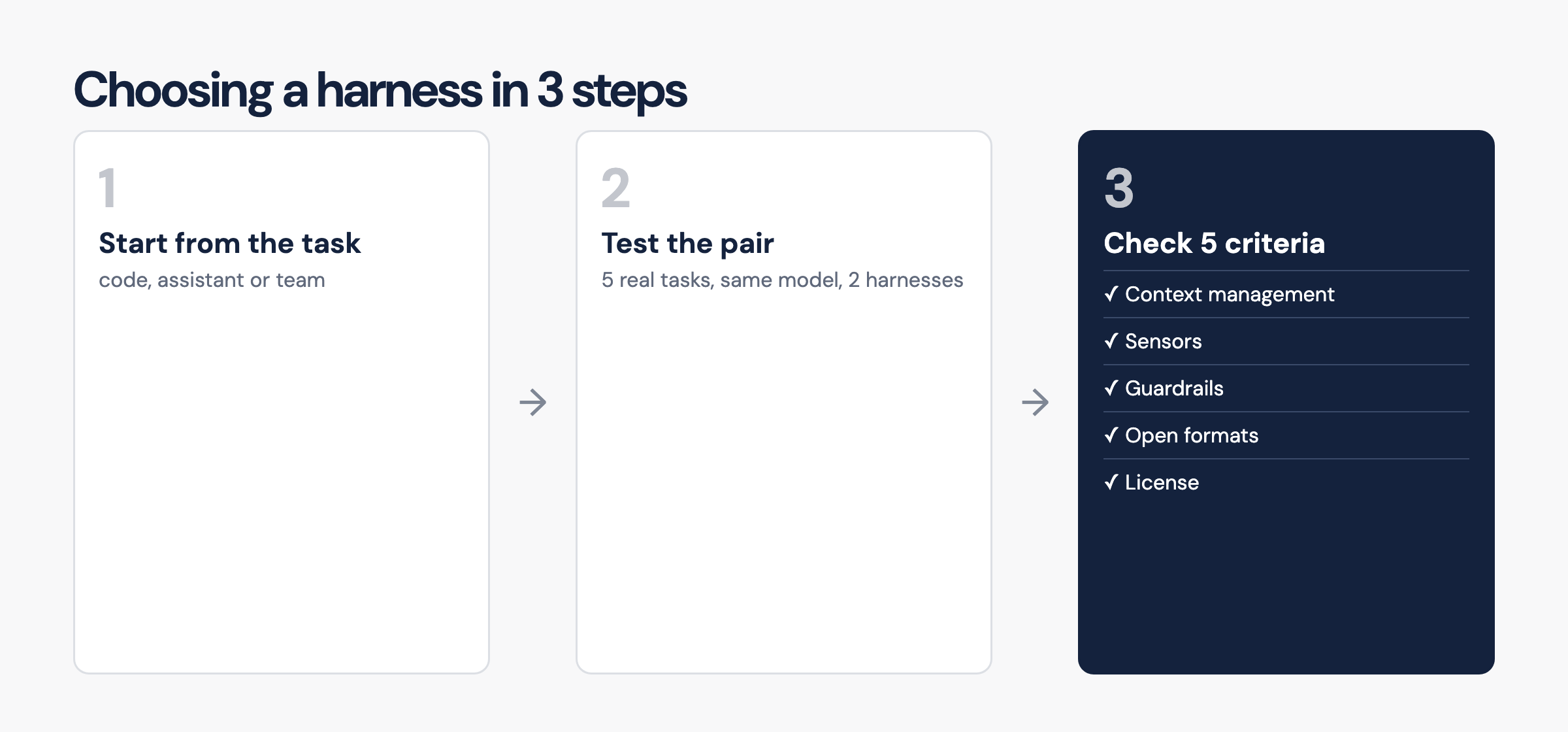
My firm opinion: don't choose a harness from a ranking. The studies show that the best pairing changes with the task. Choose based on your use case, then test.
Start from the task. Code in a repository: Claude Code, Codex or Pi. An assistant that runs continuously and answers you on Telegram: Hermes or OpenClaw. Several agents handing work to each other: OpenBot.
Test the model and harness pairing on your tasks. Take five real tasks, run them in two harnesses with the same model, compare the result and the cost. It is the only measurement that matters for you.
Look at context management. Does the harness summarize a long session cleanly? Does it load instructions on demand or all at once? This is where quality on long tasks and your bill are decided.
Check the sensors. Can you plug in tests, checks, automatic review? A harness without a verification loop leaves you rereading everything.
Demand guardrails. Approval requests before sensitive actions, sandbox, per-tool permissions. The more access the agent has (email, site, client account), the more critical this is.
Favor open formats. Instructions in
AGENTS.md, skills in the agentskills.io format, tools via MCP: your know-how stays portable if you switch harness.Read the license. MIT, proprietary or non-commercial: for client work, it changes everything.
Can a well-built harness improve SEO?
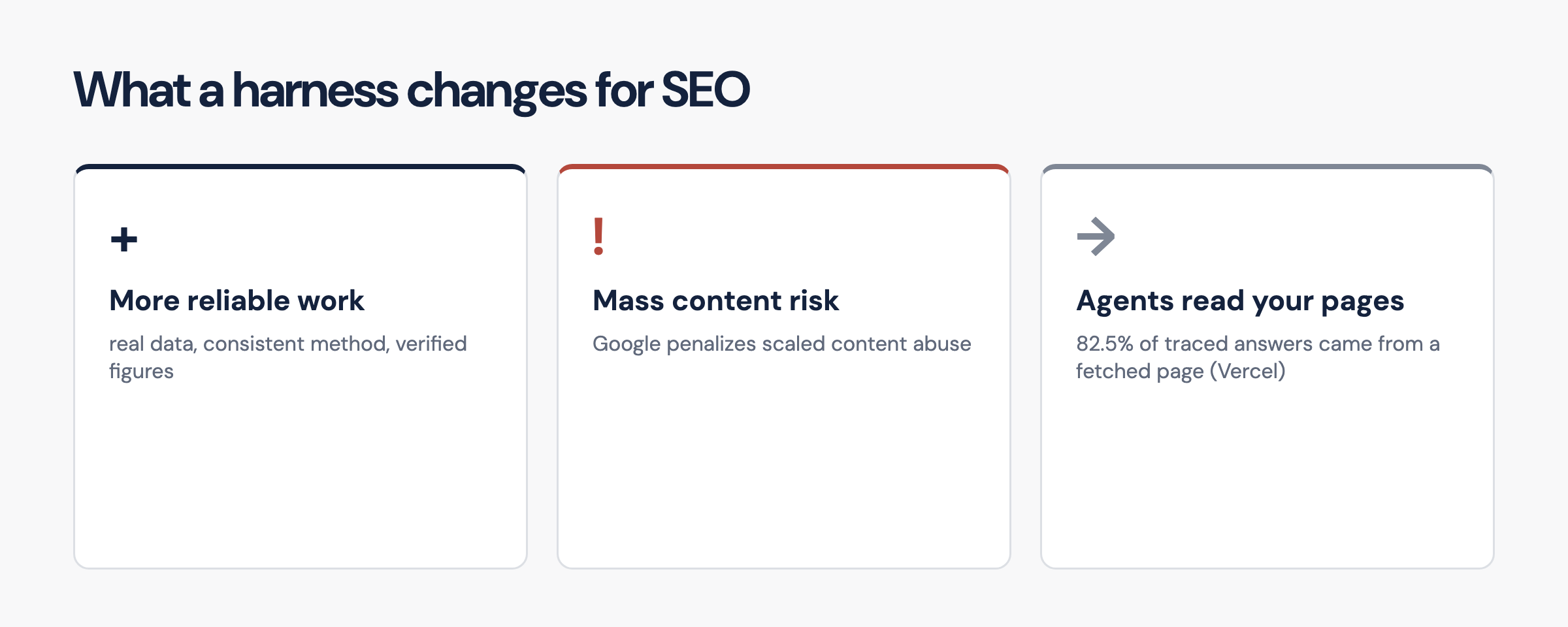
Short answer: not directly, but yes through three paths, one of which can also hurt you.
1. It makes SEO work more consistent and better sourced
Google doesn't see your harness. It sees your pages. The harness acts upstream, on the quality of the work. Semrush describes agentic SEO as handing a defined SEO process to an agent that fetches its own data, follows a documented method and delivers the same analysis every time. Their setup has four layers: a project that carries the company's context, skills that carry the method, MCP connectors that bring back fresh data, and a prompt that carries only the task at hand.
That is exactly the harness vocabulary. An agent that reads your real Search Console data, applies the same audit grid every month and checks its figures before delivering them does a better job than a chat where you paste an export. The SEO gain comes from there: fewer errors, more consistency, more time for decisions.
2. It can also produce mass content, and that is a risk
A harness makes it very easy to produce hundreds of pages. Google is explicit: generating many pages with AI without adding value for users can violate its scaled content abuse policy, and sites that break its spam policies may rank lower or disappear from the results. A good harness is also configured to say no: human review, source checks, no page created for a single keyword.
3. Harnesses are also your new visitors
This is the most underrated point. When ChatGPT, Claude or a browsing agent answers a question, a harness goes and reads your pages. Vercel and the ora.ai lab observed 1,033 agent sessions across 25 sites between June and August 2026:
Of 1,023 answers whose origin could be traced, 844, or 82.5%, came from a page that was actually fetched.
In their controlled tests, an answer hidden behind JavaScript was not retrieved by a client that simply downloads the page. A
403error blocked both clients tested.
Their results describe their sample, not the whole web, and they say so. But the lesson for GEO is clear: a page that is readable in HTML and accessible without blocking is more likely to be cited by an agent. Basic technical SEO becomes the condition for existing in agents' answers.
What I would do in your place
Pick a harness and stick with it for three weeks on real SEO tasks: monthly audit, rank tracking, technical check.
Write your methods as skills rather than copy-pasted prompts: one skill per process, with its rules and its checks.
Plug in your data (Search Console, Analytics, crawler) via MCP, so the agent works on real data.
Add a sensor to every deliverable: a figure gets checked against its source before it goes out.
Test your pages the way an agent sees them: fetch them without JavaScript and check that the answer is in the HTML.
Summary
The harness is the half of the agent that nobody talked about a year ago. The 2026 measurements show that it can swing a result by several dozen points with the same model. To choose one, start from your task, test on your own cases and keep your methods in open formats.
For SEO, there is no shortcut: a harness does not make a site rank. It makes the work more reliable, it can also industrialize worthless content, and it is now the visitor that decides whether your pages get cited. It plays out on these three fronts.