For fifteen years, SEO was steered by a single curve: clicks. It goes up, everyone is happy. It goes down, everyone worries. That habit is becoming dangerous, because clicks measure less and less of what we think they measure.
When an AI-generated answer appears at the top of the page, the user reads it, sometimes finds it sufficient, and doesn’t click. Your page may have been read, cited and remembered without your click curve moving by a single pixel. Conversely, you can win clicks that earn you nothing.
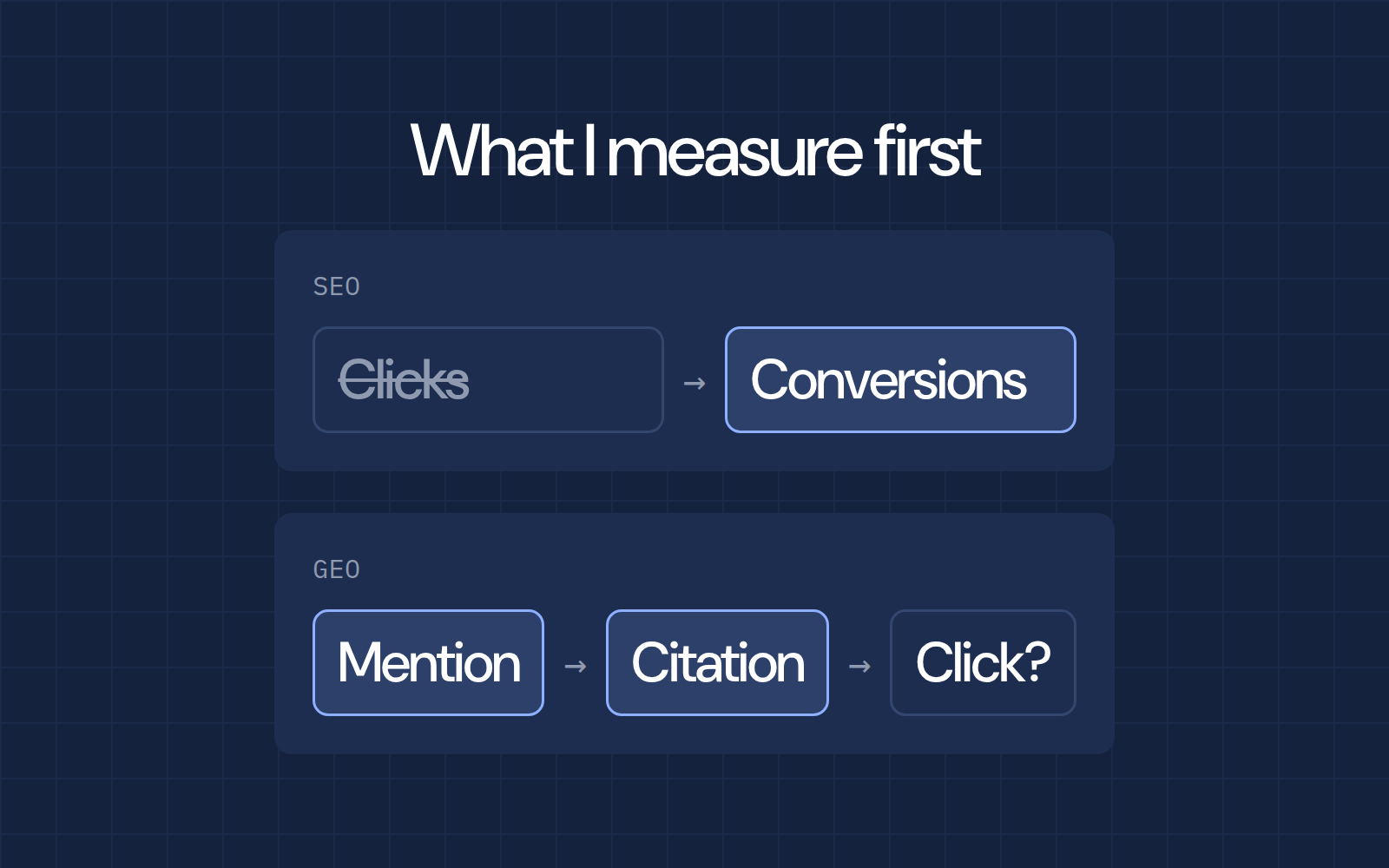
Here is why I think clicks should stop being the main indicator, what the published studies say, and what I would put in their place: conversions on the SEO side, mentions and citations on the GEO side.
Key takeaways
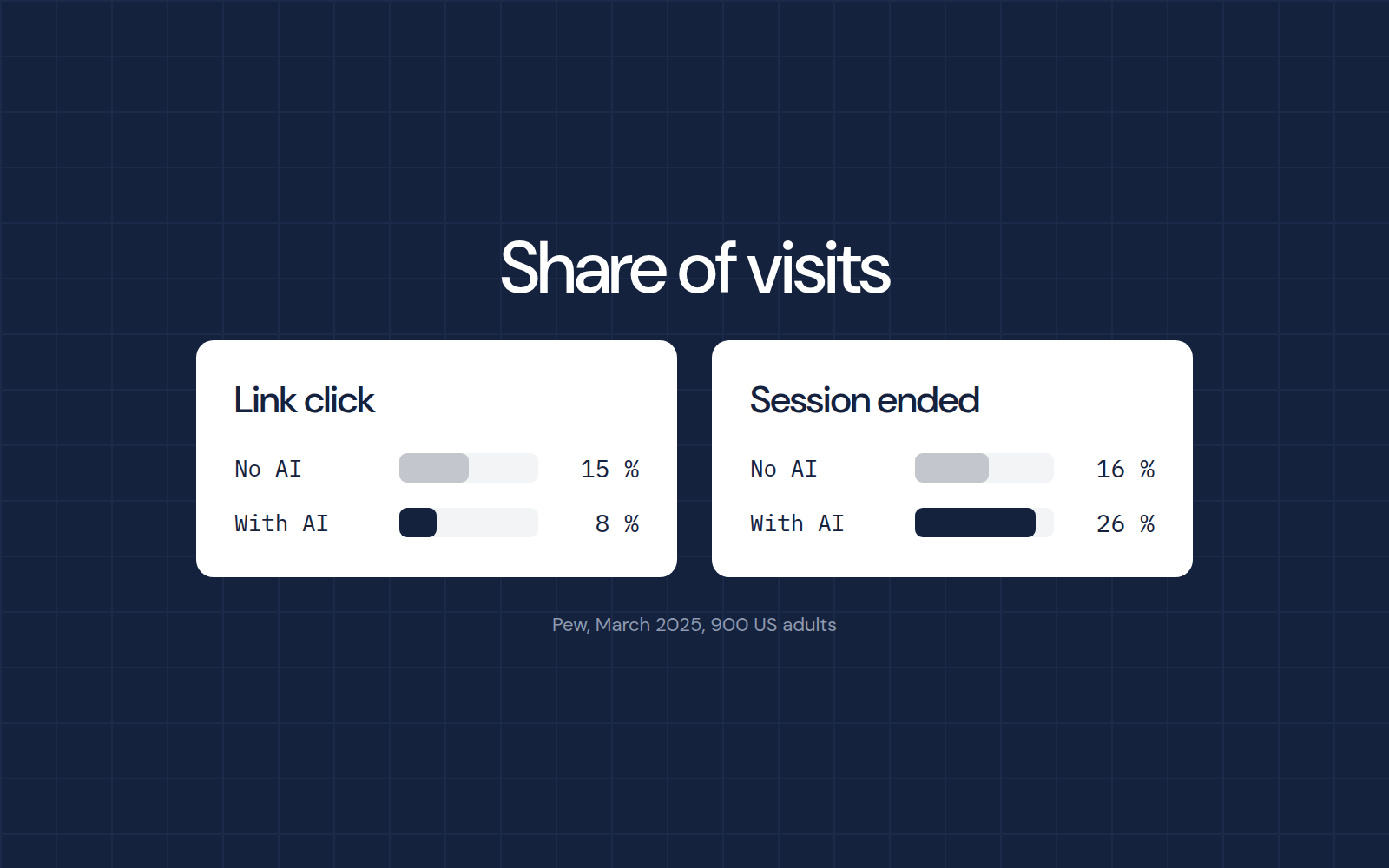
In Pew’s study of 900 American adults (March 2025), clicks on a traditional link fall to 8% of visits when an AI summary appears, versus 15% without one.
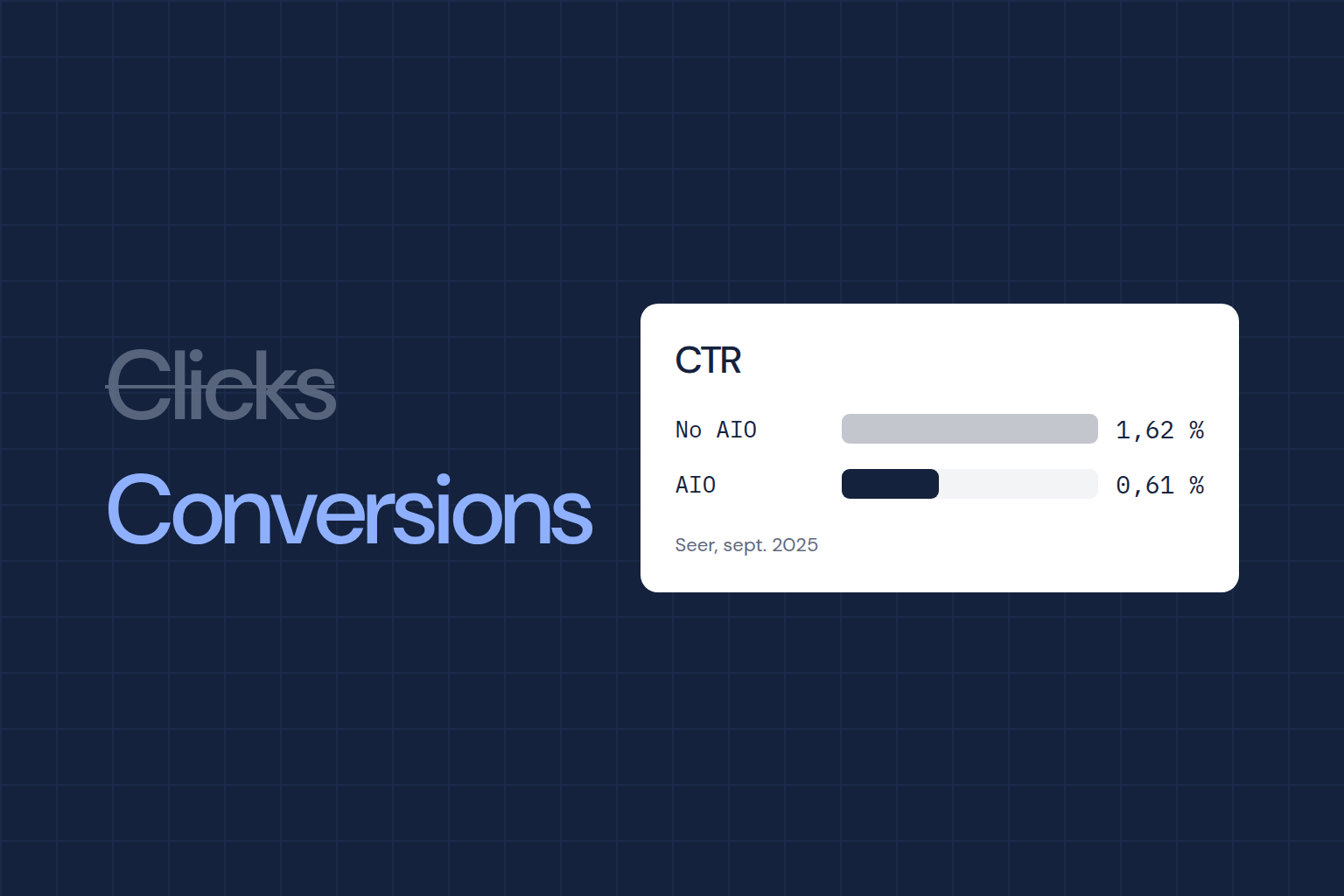
In Seer Interactive’s study (3,119 informational queries), organic CTR is 0.61% with an AI Overview and 1.62% without, in September 2025.
At Seer, a brand cited in the AI Overview has a CTR of 0.70% versus 0.52% if it is not cited. Seer says it cannot prove that the citation is the cause.
Google itself recommends looking at the value of visits (sales, sign-ups, engagement) rather than clicks alone.
Why clicks no longer tell the truth
A click measures one thing only: someone left a results page to go to yours. It doesn’t tell you why, what they did next, or what they thought of your brand before clicking.
With AI answers, the journey changes. The Pew Research Center tracked the browsing of 900 American adults in March 2025. When a Google results page displayed an AI summary, participants clicked a traditional link in 8% of visits, versus 15% without a summary. Clicks on a link inside the summary itself accounted for only about 1% of visits. And the session ended on that results page in 26% of cases with a summary, versus 16% without.
These are American data, in English, over a single month. I read them as a direction, not as a rate to apply to your site.
What CTR studies measure (and what they don’t say)
Seer Interactive publishes a regular tracking study. In its September 2025 update, covering 3,119 informational queries from 42 organizations, September organic CTR is 0.61% when an AI Overview is present, versus 1.62% without. Even without an AI Overview, Seer observes a decline: people click less everywhere.
But the picture is not fixed. According to a Search Engine Journal article dated April 26, 2026, a later Seer analysis (5.47 million queries, 53 brands) shows organic CTR on pages with an AI Overview rising from 1.3% in December 2025 to 2.4% in February 2026. Seer talks about stabilization, not a rebound, and advises against making forecasts from two months of data.
In other words, the CTR level keeps moving, and nobody yet knows where it will settle. That is one more reason not to build a strategy on it.
| Source | What it measures | Figure | Author’s caveat |
|---|---|---|---|
| Pew (March 2025) | Click on a traditional link, 900 US adults | 8% with an AI summary, 15% without | One month, United States |
| Seer (Sept. 2025) | Organic CTR, informational queries | 0.61% with AIO, 1.62% without | Doesn’t apply to transactional or local queries |
| Seer (Dec. 2025 to Feb. 2026) | Organic CTR on pages with AIO | 1.3% then 2.4% | Stabilization, no forecast from two months |
On the SEO side: track conversions, not visits
A click is an entry cost. What matters is what happens afterwards: quote request, sign-up, purchase, phone call, booked appointment. Google says it in its own way in its article on succeeding in AI search: clicks coming from AI Overviews are said to be of higher quality, with more time spent on the site, and you risk optimizing badly if you focus too much on clicks rather than on the overall value of visits. Google cites conversion indicators such as sales, sign-ups, engagement or looking up information about the business.
Be careful: this is Google’s claim, not an independent measurement. I keep it mainly for its practical consequence, which holds without it: two pages with the same traffic can earn ten times more or ten times less.
What I would put on a dashboard
Conversions from organic search, by landing page and by query type.
Conversion rate rather than session volume: it is a ratio internal to a single source, so it is more robust.
Revenue or value per visit when the site sells online or qualifies leads.
Brand queries tracked separately: a brand that is talked about more gets searched more.
Clicks remain useful, but as a diagnostic indicator, not as a goal. One click less on a page that doesn’t convert is not a problem.
A measurement trap: Search Console mixes everything
Another reason to distrust clicks alone. According to Search Engine Roundtable (June 17, 2025), AI Mode clicks, impressions and positions are counted in Search Console totals, with no filter to isolate them. Each follow-up question is treated there as a new query. Your impressions and positions therefore also move for counting reasons, not only because of performance.
On the GEO side: track mentions and citations
In AI engines, visibility is won before the click, sometimes without any click. Two things can be counted: the mention (the brand is named in the answer) and the citation (one of your pages is given as a source).
Is there any value in being cited even when nobody clicks? Seer’s data points that way, with caution. In the third quarter of 2025, organic CTR is 0.70% when the brand is cited in the AI Overview, 0.52% when it isn’t, and 1.45% without an AI Overview. Seer states that it cannot prove the citation causes this higher CTR: high-authority brands may simply be more likely to be cited.
The GEO indicators I would track
Mention rate: on a fixed panel of questions, the share of answers in which the brand is named.
Citation rate: the share of answers in which one of your domains appears among the sources.
Mention context: recommended, compared, or cited as a counter-example.
Comparison with 3 or 4 competitors on the same panel, because an isolated value means nothing.
These measurements are noisy: an AI answer varies from one query to the next. You need a stable panel, repeated at regular intervals, and you should read trends rather than values.
Actionable lessons: what I would do on Monday morning
Link organic search to conversions. If goals are not configured in the analytics tool, that is the first job.
Reclassify your pages into three groups: those that convert, those that attract without converting, and those that do neither. Clicks alone would not have made that distinction.
Replace the title of the monthly report: “SEO conversions” first, clicks in a diagnostic appendix.
Build a panel of 30 to 50 questions that your customers really ask, and record mentions and citations each month for you and your competitors.
Stop comparing sessions and clicks as if they measured the same thing. Headline on rates and on revenue.
Limits
I measured nothing myself for this article: all the figures come from the cited studies, with their own caveats.
Pew’s data are American and cover one month. Seer’s concern informational queries and a sample of agency clients, and Seer indicates that results may differ for commercial or local queries. Its more recent tracking shows CTR rising again, which makes any extrapolation fragile.
I also have no proof that mentions and citations translate into revenue. It is a reasonable hypothesis, to be checked for each business against actual sales. Finally, I am not saying clicks are useless: they remain a diagnostic signal. I am saying they should no longer be the goal.