There is one psychological profile that will never benefit from AI.
It’s not the “non-tech” person. It’s not the reflexive sceptic who thinks everything was better before, either. It’s subtler than that, and you’ll find it in a lot of marketing teams.
To explain it, let me tell you about Tiphaine.
Tiphaine, Kevin and their company are made up. I picked a first name at random: Tiphaine, Typhon, Martin or Abdel Kader, it makes no difference. The situations, though, many people will recognise.
Key takeaways
Generative AI is a probabilistic tool: it produces a draft, not a verdict.
The main barrier to adoption is not technical skill. It’s how you relate to being wrong.
The profile that will never benefit is the one that needs to be right the first time.
Rigorous checking is the skill AI users lack most. Sceptics already have it.
Tiphaine, an ultra-rational Head of Marketing
Tiphaine is Head of Marketing. She’s an “ultra-rational” profile.
She first did a Master’s in finance. Then the 2008 crisis hit, and she switched to a Master’s in e-commerce. What draws her in is numbers, calculations, tangible things, hard science.
She wanted to become a data scientist. But there was too much “IT”. So she settled for marketing.
Today she loves dissecting spreadsheets, finding the flaw and selling correlations to her leadership team. Something like:
“Two thirds of the 20% revenue drop comes from lower direct traffic, correlated with the end of the March TV campaign, and one third from the erosion of non-brand SEO on generic queries after the last core update, with partial cannibalisation of brand by paid.”
Leadership loves it. It’s precise, it’s quantified, it’s reassuring.
In Tiphaine’s world, the same formula applied to the same cells always returns the same result. That’s what makes Excel trustworthy. And that’s exactly what is about to trip her up.
The day the board asked for “an AI strategy”
Enter ChatGPT. The board wants an AI strategy for next quarter. Tiphaine does what she knows: she tests.
First prompt: “Calculate the ROAS of our March campaigns.” She pastes an export. The AI returns a number. The number is wrong: the model misread a column.
Screenshot sent to the team: “There you go. It makes things up.”
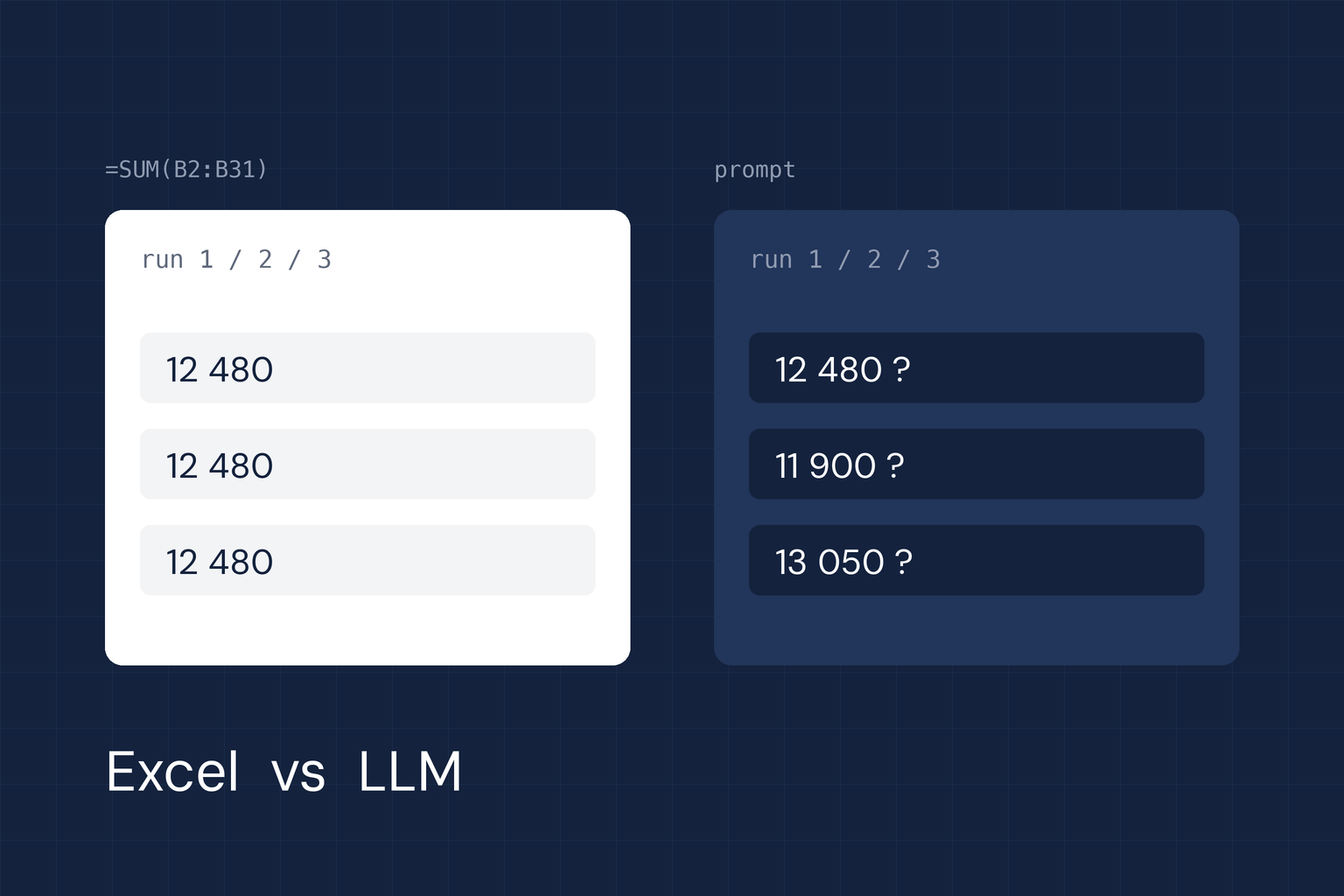
Second try, to be fair. She asks the same question three times. She gets three different answers.
For her, that’s final proof. A tool that doesn’t give the same result twice isn’t a tool. It’s a noise generator.
Tab closed. Case closed.
Meanwhile, Kevin asks silly questions
On the same team, there’s Kevin. Kevin doesn’t have a Master’s in finance.
Kevin asks the AI silly questions. He gets things wrong, starts again, rephrases, asks “why?”, and starts again. When an answer is wrong, he doesn’t take a screenshot: he corrects it and asks again.
In three weeks, Kevin has:
written a Python script to pull Search Console data, without knowing how to code;
automated the weekly report that used to take Tiphaine half a day;
combined sales, SEO traffic and weather data to better understand seasonality.
In other words, Kevin is doing data science.
The job Tiphaine wanted. The one she gave up because of “IT”.
The barrier that stopped her is coming down. And she can’t see it, because she closed the tab.
The problem isn’t intelligence, it’s how you relate to being wrong
Tiphaine is probably smarter than Kevin. That’s not the point.
Her problem is how she relates to error.
A language model is a probabilistic tool. With every answer, it picks words based on probabilities. Asking the same question twice and getting two different answers isn’t a bug: it’s how it normally works. It’s often right, sometimes wrong, and says both with the same confidence.
If you expect a calculator, you’ll be disappointed every time. If you treat it like a brilliant intern who occasionally makes things up, you’ll save weeks.
There’s an extra irony. Tiphaine, the team’s scientist, used the worst possible experimental protocol: one attempt, on one task, the worst-chosen one (a calculation), and a sweeping conclusion. If an intern had tested a campaign like that, she would have sent them back to redo it.
So the profile that will never benefit from AI isn’t the rational one. It’s:
the one who needs to be right the first time;
the one who refuses to be a beginner in front of others;
the one who would rather prove a tool is bad than learn how to use it.
Three signs you’re (a bit of) a Tiphaine
You judge a tool on its first try. One bad answer is enough to close the subject.
You share AI’s mistakes more readily than what it saved you. The hallucination screenshot travels faster than the time saved.
You’d rather not use a tool than be seen using it badly. The perceived risk isn’t technical, it’s social.
The real irony: her rigour is exactly what’s missing
Tiphaine’s strength is the one many AI users lack: checking.
Spotting the wrong number. Verifying the source. Rejecting a shaky correlation.
Kevin moves fast. But sometimes he copies a wrong answer without rereading it. The day that number ends up in a leadership meeting, the whole team loses credibility.
If Tiphaine put her scepticism to work on verification rather than rejection, she’d become the best on the team. Kevin produces fast. Tiphaine would produce accurately. Together, they’d be formidable.
How to reopen the tab
If you recognised yourself in Tiphaine, here’s where I’d start.
Change the question. Stop asking “is it reliable?” and ask “on which tasks is it reliable, and how do I check?”.
Start where mistakes are cheap. An outline, a draft, a rewrite, a throwaway script. Not a number going to the board.
Take the calculation out of the model. Instead of asking for the ROAS, ask for the formula or script that computes it, then run it yourself. The number comes from your spreadsheet, not from the chat.
Iterate. The first answer is a starting point. Clarify, correct, ask “why?”. The value is in the third or fourth answer.
Always verify. Numbers, sources, quotes. That’s where your rigour becomes an advantage instead of a brake.
What about you?
AI doesn’t reward the smartest or the most technical people. It rewards those who accept being wrong often, fast and in public, then check before they deliver.
Tiphaine has everything it takes to get the most out of it. She’s missing just one thing: reopening the tab.
So, does your team have more Tiphaines or more Kevins?