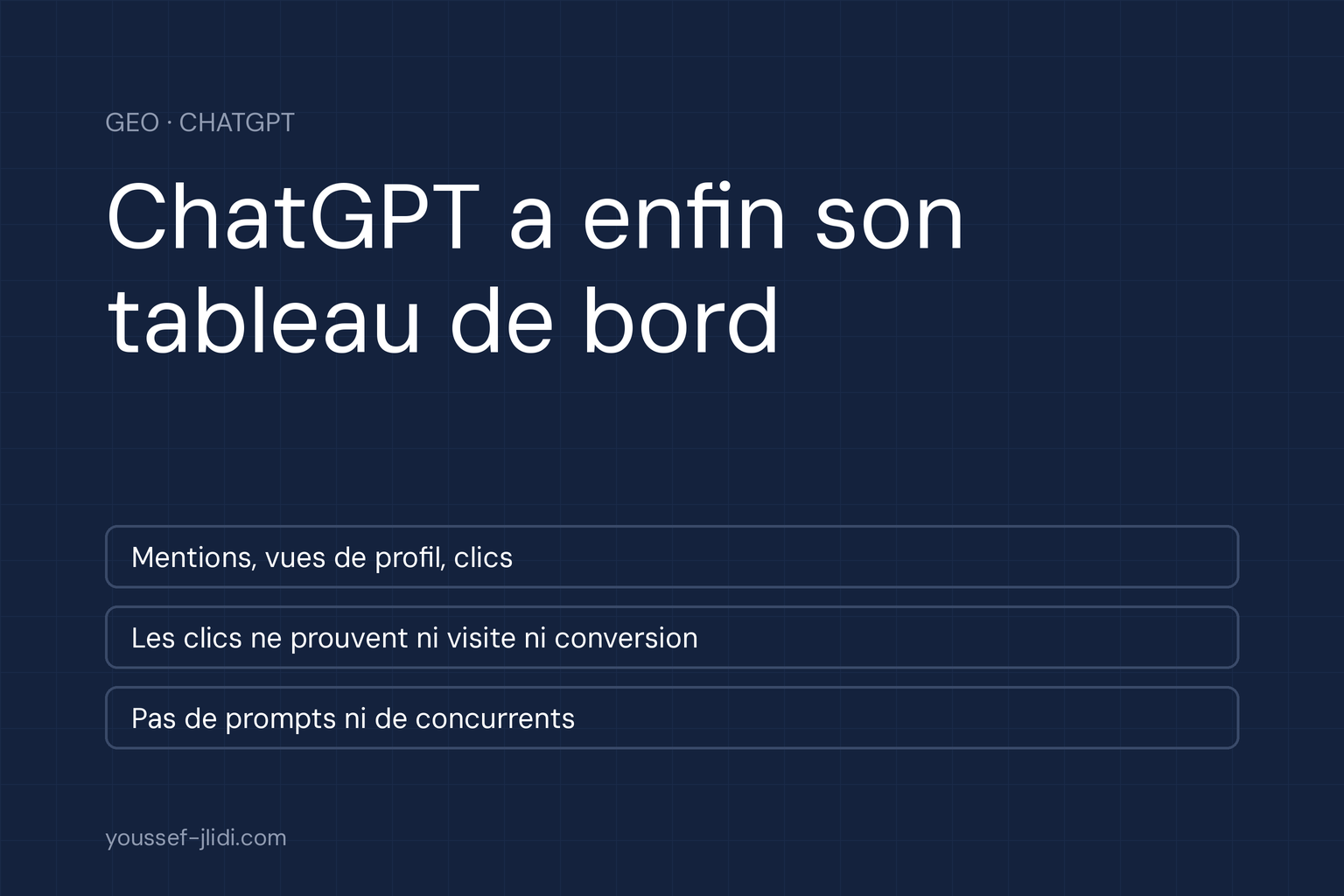
According to Search Engine Roundtable, OpenAI opened a beta on 10 November 2026 of what everyone is already calling ChatGPT’s Search Console. The official name is more sober: “Businesses in ChatGPT”, with a space called the Business Hub. A company can now see how many times ChatGPT has mentioned it and how many clicks went to its website.
This is good news for GEO, because until now visibility in ChatGPT was measured from the outside, with third-party tools that test prompts. But read the details before getting carried away. This is not equivalent to Google’s Search Console, and several definitions have not been published.
Here is what was announced, what the tool shows and doesn’t show, how it compares with what Bing already does, and what I would do on Monday morning. All the information comes from the trade press: I could not open OpenAI’s own pages (access denied), and I have not tested anything.
Key takeaways
According to Search Engine Roundtable (10 November 2026), OpenAI announced a beta of “Businesses in ChatGPT” with a Business Hub: mentions, profile views and clicks to the website.
According to the same source, a tooltip states that clicks do not confirm a visit or a conversion. They should therefore not be treated as measured traffic.
On 6 November, according to Juozas Kaziukėnas’s findings, the tool showed no prompts, no user data and no comparison with competitors.
Ownership is verified by SMS, a call to the company’s phone number or DNS. For now, Business Agents are limited to eligible US companies.
Bing has offered a citation report in its Webmaster Tools since 10 February 2026. ChatGPT is therefore arriving later.
What happened in four days
On 6 November, Juozas Kaziukėnas (of Marketplace Pulse) posted a screenshot on LinkedIn. Barry Schwartz relayed it the same day on Search Engine Roundtable: a “Claim your business in ChatGPT” banner and a chart of impressions and clicks. At that point, OpenAI had announced nothing, and Kaziukėnas says he has seen traces of the feature since August.
On 10 November, the same site reported the launch. According to that article, OpenAI published a blog post and a help page for “Businesses in ChatGPT”. I could not open either page, so everything that follows about the launch rests on that report.
What changes between the two dates matters: we go from a leak to an announcement, but the product remains a beta.
What the Business Hub shows
According to Search Engine Roundtable, the Business Hub lets you claim your company’s listing, manage its information and view statistics. These statistics cover three things: mentions, profile views and clicks to the website. The tool adds “discovery topics”, meaning the recurring themes of the conversations where the site is cited.
The second component is Business Agents. According to the article, they start with “eligible US e-commerce and online service businesses”.
For verification, three methods exist: SMS, a call to the main phone number or DNS verification. The author chose DNS and had no data yet. Other users, quoted on X, had received some.
What it doesn’t show
This is where the “Search Console” label becomes misleading. According to Kaziukėnas’s findings of 6 November, relayed by PPC Land, the tool displayed no prompts, no user data and no competitive benchmark. It therefore doesn’t tell you why your mentions rise or fall.
PPC Land also lists what is left unspecified:
the definition of an “impression”;
how repeated appearances within a single conversation are handled;
exports, the API, pricing and data retention period.
The same article counts that the tool covers 3 of the 12 features requested by Glenn Gabe in a 2025 essay on an “AI Search Console”: impressions, clicks and a trend curve. That is PPC Land’s count, not mine.
One last point of caution comes from Barry Schwartz: he is concerned about the risk of listing impersonation, though the article doesn’t say how OpenAI plans to address it.
Comparison with Bing and Google
Bing is ahead. On 10 February 2026, Microsoft launched AI Performance in Bing Webmaster Tools, in public preview. The dashboard covers Copilot, AI-generated summaries in Bing and some partner integrations.
| Criterion | Bing, AI Performance | ChatGPT, Business Hub |
|---|---|---|
| Status | Public preview (February 2026) | Beta announced (November 2026) |
| Main metric | Total citations, average cited pages per day | Mentions, profile views, clicks |
| Page-level detail | Yes, citations by URL | Not documented in the sources read |
| Queries | Grounding queries, a sample | Discovery topics (themes) |
| Stated limits | No ranking or authority, sampled query data | Clicks without proof of a visit, unpublished definitions |
The table shows a difference in logic. Bing reasons by cited page. ChatGPT reasons by verified business, which suits a merchant with a shop better than a publisher with thousands of articles. At this stage, nothing in the sources says the Business Hub breaks data down by URL.
Google, for its part, doesn’t isolate its AI answers in a separate report: I haven’t checked the current state of its reports for this article, so I won’t venture a claim.
What this changes for GEO
First effect: we get first-hand data on the ChatGPT side. In my view, it should be cross-checked against external prompt-tracking tools: it doesn’t replace them, it calibrates them.
Second effect: the Business Hub’s clicks are no substitute for your analytics. The tooltip as reported says so itself. That echoes what I argue in my article on ending click-based steering: a mention and a click are signals, not outcomes. Conversion is read on your own side.
Third effect: access to the tool depends on verified ownership. Crawling, meanwhile, is still managed through robots.txt. According to OpenAI’s documentation on its bots, OAI-SearchBot is used to surface sites in ChatGPT’s search results, while GPTBot relates to training. The settings are independent: you can allow one and block the other. OpenAI’s systems take about 24 hours to adjust after a robots.txt update.
Actionable lessons: Monday morning
Check your robots.txt. If OAI-SearchBot is blocked, no dashboard will save you. Check this before anything else.
Claim your listing. If you are a business (shop, online service), start the verification. DNS requires access to your zone, and data may take time: Schwartz had none yet at publication.
Set a baseline. Record mentions, views and clicks every week as soon as data appears. Without history, the curve will tell you nothing in three months.
Cross-check with your analytics. Compare the announced clicks with the sessions in your tool. If the gap is large, that is information, not an error to fix.
Monitor the listing. Regularly check that the information displayed is correct, given the impersonation risk raised.
Don’t rebuild your strategy. Until the definitions are published, these are trend indicators, not contractual KPIs.
Limits
I could not open OpenAI’s post or its help page: my reading of the launch comes from Search Engine Roundtable and PPC Land, and the 10 November date is not confirmed on OpenAI’s site. The details on what the tool doesn’t show date from 6 November, before the official launch, and may have changed. I have not tested the tool, I don’t know whether it is open outside the United States (the article specifies a restriction only for Business Agents), nor whether it serves a publisher without a shop. The definition of a mention or a click is unknown. Finally, all of this remains a beta: “for now” applies to every sentence of this article.
Sources
Search Engine Roundtable, OpenAI Working On ChatGPT Tools For Business For Analytics & Citations
Search Engine Roundtable, annonce du Business Hub de ChatGPT (10 novembre 2026)
PPC Land, ChatGPT builds mention and click charts for verified businesses
Microsoft Bing, Introducing AI Performance in Bing Webmaster Tools Public Preview